- Agricultural Engineering and Technology
- Applied Physics
- Built Environment
- Computing and Networks
- Control, Robotics and Sensors
- Electrical Regulations
- Electromagnetics and Radar
- Energy Engineering
- Healthcare Technologies
- History and Management of Technology
- IET Codes and Guidance
- Manufacturing
- Materials, Circuits and Devices
- Model Forms
- Security
- Telecommunications
- Transportation

In stock
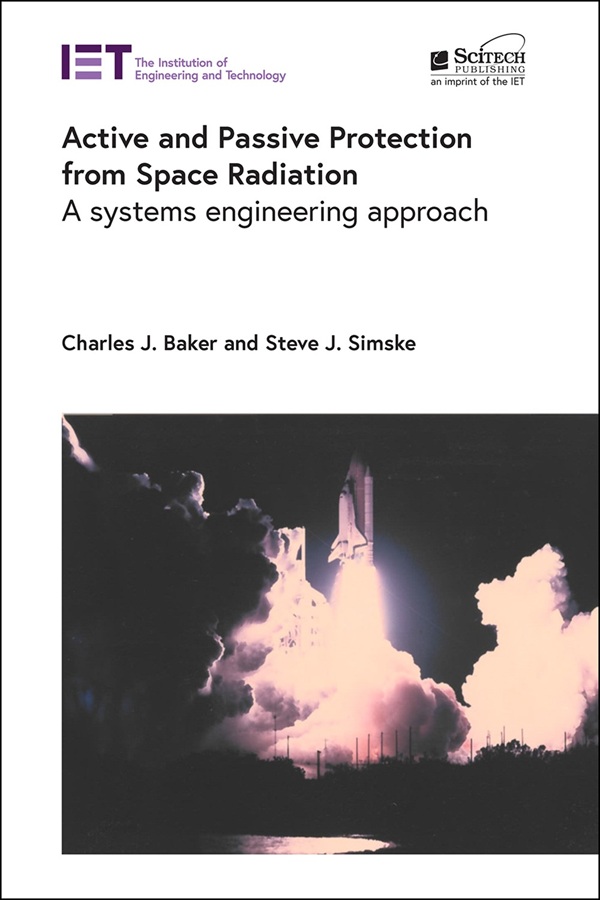
Active and Passive Protection from Space Radiation
A systems engineering approach
by Charles J. Baker, Steve J. Simske
The space radiation environment is one of the main limitations of human and robotic exploration of space beyond low Earth orbit. This book presents, in a technical reference and engineering handbook format, the underlying principles, architectures, and integration challenges associated with protecting spacecraft and astronauts from the complex radiation environment of deep space. It is intended to serve as a practical guide for researchers, engineers, and mission planners seeking to understand how and why various shielding approaches function, such as active magnetic fields, passive materials, and bioengineered countermeasures; how they may fail, and how they can be integrated into coherent, mission-tailored protection systems.
Rather than focusing narrowly on any single technology, the text synthesizes multiple disciplines: electromagnetics, materials science, and plasma physics, each examined through the lens of systems engineering. It explores the governing physics of galactic cosmic rays and solar particle events, the performance limits of superconducting and resistive magnetic field generators, the trade-offs inherent in hydrogen-rich and boron-infused composites, the generation and mitigation of secondary radiation. A central emphasis is placed on model-based systems engineering (MBSE) methodologies, which provide the connective tissue for integrating these diverse technologies into mission-ready architectures.
Although grounded in rigorous modeling and simulation, the book is not intended as an academic treatise full of derivations and proofs. Instead, it strives to bridge theory and application, offering a clear framework for practitioners to diagnose, model, and mitigate radiation risks in spacecraft design. References are provided throughout to enable readers to pursue specialized areas of interest.
Beyond its coverage of shielding solutions, this book provides a framework for thinking in an integrated systems approach rooted in physics, guided by engineering pragmatism, and oriented toward the long-term sustainability of human presence beyond Earth's magnetosphere.
Written by two experts in the field, Active and Passive Protection from Space Radiation: A systems engineering approach offers an opportunity to learn from authors with broad cross-disciplinary experience and hands-on knowledge of space programs. Professionals, researchers and graduate students working in space systems engineering and mission architecture, aerospace radiation environments and shielding design, model-based systems engineering and digital mission modelling, will find this book worth reading.
About the Author
Charles (Chuck) Baker is a senior manager and systems engineer (modeling, analysis, and simulation operations) at Raytheon RTX, USA. He has worked as a flight project systems engineer and flight operations engineer for the Mars Exploration Program Office and Earth Science Mission Office at NASA's Jet Propulsion Laboratory. Chuck retired from the US Air Force in May 2018 after serving 17 years in the Naval Service and 6 years in the Air Force.
Steve Simske is a professor of systems engineering at Colorado State University, USA. Previously, he was at a NASA Center for the Commercial Development of Space (1990-94, part-time till 2007) and at HP from 1994 to 2018, where he was an HP fellow, vice president, and director in HP Labs. He is the author of 7 books and more than 500 publications with more than 240 US patents. He is an IEEE, NAI and IS&T Fellow, and was IS&T President (2017–19).
Publication Year: 2026
Pages: 238
ISBN-13: 978-1-80705-190-7
Format: HBK