- Agricultural Engineering and Technology
- Applied Physics
- Built Environment
- Computing and Networks
- Control, Robotics and Sensors
- Electrical Regulations
- Electromagnetics and Radar
- Energy Engineering
- Healthcare Technologies
- History and Management of Technology
- IET Codes and Guidance
- Manufacturing
- Materials, Circuits and Devices
- Model Forms
- Security
- Telecommunications
- Transportation

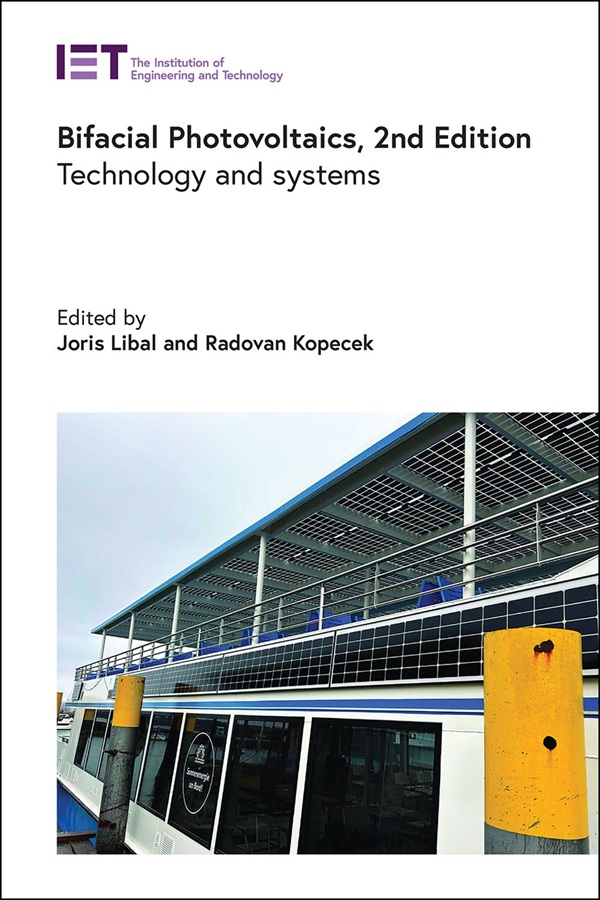
Bifacial Photovoltaics, 2nd Edition
Technology and systems
Edited by Joris Libal, Radovan Kopecek
Bifacial photovoltaic technology has completed its transition from an emerging innovation to a mainstream solution within the solar industry. Bifacial modules are no longer regarded as a niche product and are now widely deployed, representing the predominant choice in most utility scale, commercial and many other solar projects. The change is being driven by the ability of bifacial PV systems to significantly increase energy yield and reduce levelized cost of energy (LCOE). Double-glass bifacial modules, in particular, offer durability, long-term stability, and enhanced performance in diverse environmental conditions.
This second edition of Bifacial Photovoltaics: Technology and systems reflects the current state of bifacial PV technology and its future direction. The new edition has been substantially updated and revised, while retaining the structure of the original, offering systematic coverage from cells through to modules, systems, applications, impact on levelized costs, and the effects of environmental conditions. The editors and contributors have taken care to ensure that the content is comprehensive enough for newcomers to understand the topics without needing to refer to the first edition. They have aimed to cover all essential elements in this key technology that supports progress towards a clean, sustainable, decentral and independent energy supply.
Attention is given to the developments in technology, manufacturing processes, standardized testing and performance outcomes that have led to bifacial photovoltaics becoming an established solution in utility-scale solar deployment. For example, advancements in cell architectures - such as PERC, TOPCon, HJT and BC tech - have further enhanced bifacial efficiency and power output. Larger wafer sizes and improved manufacturing processes continue to drive down costs, making bifacial modules an economically attractive choice worldwide. The development of standardized testing, performance measurement, and quality assurance practices has helped instil confidence among investors and project developers.
Bifacial Photovoltaics, 2nd Edition: Technology and systems offers insightful and thorough coverage of this increasingly important topic for researchers in academia and industry involved in solar cell and solar cell module development. It is also a valuable resource for grid operators, policy makers, and anyone in the energy engineering field.
About the Editors
Joris Libal is a project manager - technology transfer at the ISC Konstanz, Germany. After obtaining his PhD at the University of Konstanz and a post-doc fellowship at the University Milano-Bicocca, he worked for the Italian company Silfab as an R&D Manager with responsibility for the company's internal and external research and development projects in the field of solar cells and PV modules, as well as for the PV module certification process (UL and IEC) for production sites in Canada and Croatia. Since 2012, he has been working at the ISC Konstanz in the field of innovative bifacial n-type solar cells and innovative module technology, as well as techno-economic analysis, technology transfer, and energy yield simulations for PV technologies.
Radovan Kopecek is the department head for strategy and education and one of the founders of the International Solar Energy Research Center (ISC) Konstanz, Germany. Prior to this, he headed several national and international projects at the University of Konstanz as a group leader. At the ISC, Dr. Kopecek has been working at the institute as a full-time manager and researcher since January 2007, serving as the head of the Advanced Solar Cells department. He is responsible for several European and national research projects that revolve around silicon feedstock and around the development of solar cells, with a focus on n-type devices for terrestrial and p-type devices for space applications.
Publication Year: 2025
Pages: 382
ISBN-13: 978-1-83953-920-6
Format: HBK
Editors: Joris Libal, Radovan Kopecek