- Agricultural Engineering and Technology
- Applied Physics
- Built Environment
- Computing and Networks
- Control, Robotics and Sensors
- Electrical Regulations
- Electromagnetics and Radar
- Energy Engineering
- Healthcare Technologies
- History and Management of Technology
- IET Codes and Guidance
- Manufacturing
- Materials, Circuits and Devices
- Model Forms
- Security
- Telecommunications
- Transportation

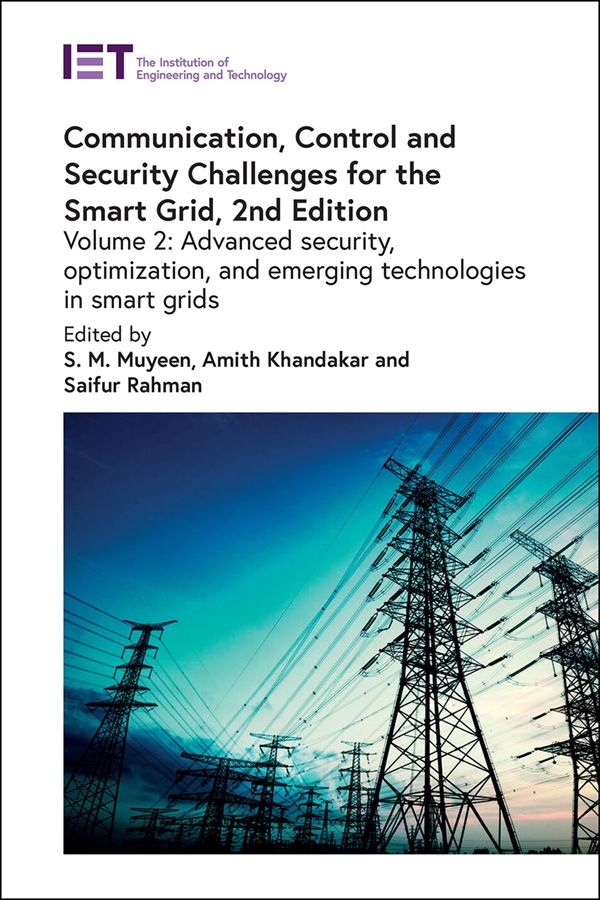
Communication, Control and Security Challenges for the Smart Grid, 2nd Edition
Volume 2: Advanced security, optimization, and emerging technologies in smart grids
Edited by S.M. Muyeen, Amith Khandakar, Saifur Rahman
Smart grids are electrical grids using ICT and two-way communications to enable varying two-way flows of electricity and information for the integration of distributed renewable generation and power storage. Research and development in this field centres on three main areas; the infrastructure system, the management system, and the protection. The integration of advanced communication, sensing, control, and optimization techniques into traditional power systems is a key challenge in transforming conventional grids into smart grids, and so empowering consumers with real-time information and control over their power usage and production.
This second edition of a well-established book strengthens the interdisciplinary approach of the original, combining technical depth with practical relevance, and offering updated information on recent developments. Content has been added on AI, machine learning, advanced power electronics, and the energy internet, highlighting their potential to revolutionize the power sector.
Volume 1 covers smart grid architecture and communications, sensing devices, WAM, bad data detection, energy management and smart distribution, role of energy storage, and integration of plug-in electric vehicles.
Volume 2 conveys multi-agent-based control, compressive sensing, stability enhancement, security analysis and related policies and regulations, controlled islanding, machine learning for solar power prediction, use of blockchain technology in smart grids, and peer-to-peer and peer-to-grid (P2G) energy trading.
These volumes are intended as references for researchers in academia and industry who are involved with power grids, related power electronics and distributed renewable generation. Policy makers, grid operators, and advanced students in electrical and energy engineering, will also find useful and relevant content here.
About the Editors
S.M. Muyeen is a professor in the Electrical Engineering Department of Qatar University, Doha, Qatar. He received his PhD from the Kitami Institute of Technology, Japan. He has published about 500 articles and has received research awards, including the IEEE WA Outstanding Engineering Award 2017. He has secured over $13 Million AUD in grants, mostly as a leading investigator. He is a fellow of IEEE, a fellow of Engineers Australia, and a chartered professional engineer.
Amith Khandakar is a distinguished researcher in sensors and instrumentation and a faculty member in the Department of Electrical Engineering at Qatar University. He has over 100 journal publications and four registered U.S. patents. An IEEE senior member, his current research focuses on the value proposition of Connected Vehicle Technology. He has secured multiple international research grants totalling over USD 1 million.
Saifur Rahman was a co-editor of the first edition of this book. He is the Joseph R. Professor of electrical and computer engineering and the founding director of the Advanced Research Institute at Virginia Tech, USA. He also directs the Center for Energy and the Global Environment at the university. He was the 2023 IEEE President and CEO. He is an IEEE Millennium Medal winner and was the president of the IEEE Power and Energy Society (PES) in 2018 and 2019. He is the founding editor-in-chief of the IEEE Electrification Magazine and the Transactions on Sustainable Energy. He has published more than 160 journal papers and has made more than 800 conference and invited presentations. He has a PhD in electrical engineering from Virginia Tech.
Publication Year: 2025
Pages: 332
ISBN-13: 978-1-83724-158-3
Format: HBK