- Agricultural Engineering and Technology
- Applied Physics
- Built Environment
- Computing and Networks
- Control, Robotics and Sensors
- Electrical Regulations
- Electromagnetics and Radar
- Energy Engineering
- Healthcare Technologies
- History and Management of Technology
- IET Codes and Guidance
- Manufacturing
- Materials, Circuits and Devices
- Model Forms
- Security
- Telecommunications
- Transportation

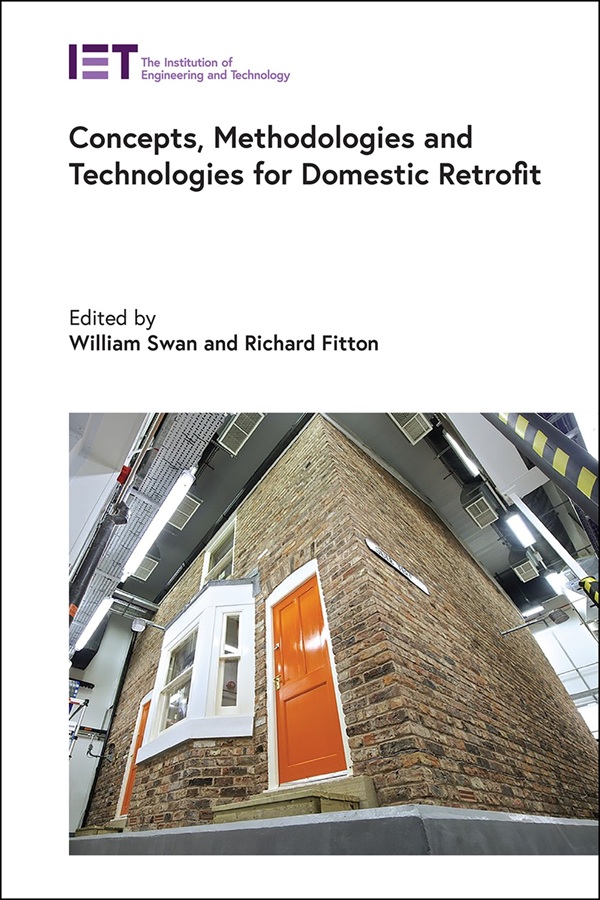
Concepts, Methodologies and Technologies for Domestic Retrofit
Edited by William Swan, Richard Fitton
Domestic retrofitting is the process of adding new features, components, or technology to an existing residential building to improve its sustainability - including performance, energy efficiency, safety, functionality, and comfort. This is done by upgrading older structures to meet modern standards, such as improving insulation, replacing windows, installing new heating systems, and reducing energy consumption to lower utility costs and environmental impact. The issue of domestic retrofit has presented itself as a "wicked problem". The complex inter-relationships between policy, skills infrastructure, supply chains, finance, markets and other socio-technical issues, have made the policy difficult to formulate and implement. Expertise needs to stretch across technical subjects such as building physics and data analytics, through delivery issues such as skills and supply chain, to understanding the outcomes for people in their homes.
Concepts, Methodologies and Technologies for Domestic Retrofit addresses three main themes: enabling retrofit, delivering retrofit and evaluating retrofit. Enabling retrofit looks at the context for delivering retrofit and understanding the structures that need to be in place to deliver the necessary upscaling. This considers place-based approaches, finance models, target setting and understanding how to develop a pipeline, particularly in harder to reach sectors such as the private rented or owner occupier sectors. Delivering retrofit considers the processes that lead to a high-quality retrofit. Effective assessment, quality systems, technical choices and the development of supply chains, all underpin an effective delivery system. Finally, the authors consider evaluation of retrofit. New methods and access to data have changed the way retrofit is understood in terms of real performance, so the authors discuss the current state of the art and emerging approaches. The outcomes are not purely technical; the impacts for people in their homes and how they have viewed retrofit are also considered, not only in terms of energy saving, but also their comfort and health.
The book is targeted not only at an academic audience, but also practitioners and policy makers. It aims to provide clear practical guidance, linkages to the latest thinking and practice and a practical perspective on the problems and opportunities presented by domestic retrofit.
About the Editors
Will Swan is a professor at and the director of the Energy House Laboratories at the University of Salford, Manchester, UK, an externally facing research unit that works with industry and the public sector around issues concerning energy and buildings, from building physics to the application of smart meters to digital energy services. He has advised government at both regional and national level around issues of retrofit and energy systems, including a recent appointment to the national Energy Efficiency Taskforce.
Richard Fitton is the professor in building performance and technical director of Energy House Laboratories at the University of Salford, UK. He leads several international projects on the energy performance of homes and the development of UK standards for retrofit assessment. He is also active at the IEA where he studies the use of smart meter data to provide energy efficiency data for dwellings. He holds a place on the SAP Scientific Integrity Group at the Building Research Establishment (BRE) and is the technical lead for the new Energy House 2 project.
Publication Year: 2026
Pages: 464
ISBN-13: 978-1-83953-404-1
Format: HBK
Editors: William Swan, Richard Fitton