- Agricultural Engineering and Technology
- Applied Physics
- Built Environment
- Computing and Networks
- Control, Robotics and Sensors
- Electrical Regulations
- Electromagnetics and Radar
- Energy Engineering
- Healthcare Technologies
- History and Management of Technology
- IET Codes and Guidance
- Manufacturing
- Materials, Circuits and Devices
- Model Forms
- Security
- Telecommunications
- Transportation

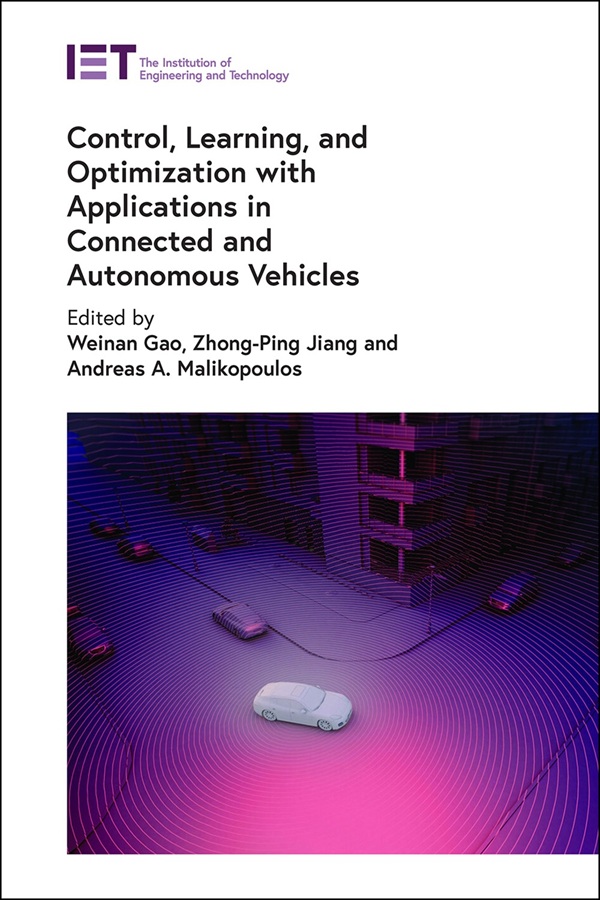
Control, Learning, and Optimization with Applications in Connected and Autonomous Vehicles
Edited by Weinan Gao, Zhong-Ping Jiang, Andreas A. Malikopoulos
Connected and autonomous vehicles (CAVs) have enormous potential to shape the future of transportation. As this complex and dynamic field grows, researchers are looking for ways to improve the efficiency and performance of CAVs. Through employing predictive modeling, machine learning, and advanced sensor fusion approaches, CAVs can anticipate and respond to hazardous situations with greater precision and speed. Control algorithms coupled with real-time data analysis enable CAVs to achieve significant reductions in energy consumption without compromising performance or safety.
This book investigates the convergence of control, learning, and optimization techniques used to enhance CAV safety, mobility, energy efficiency, and overall performance, helping readers gain a deeper understanding of the key developments and emerging trends in CAV technologies.
It includes chapters on human-vehicle shared control, vehicle platooning, motion prediction and planning for autonomous vehicles, predictive and adaptive cruise control, reinforcement learning, energy optimisation, as well as cyber-security and privacy issues in learning-based vehicle control.
This book is a comprehensive resource for researchers and advanced students interested in the transformative potential of CAVs in future transport and looking for further insights to navigate this complex and dynamic field.
About the Editors
Weinan Gao is a professor at Northeastern University, China. He received his PhD from New York University and previously held positions at Florida Tech, Georgia Southern, and MERL. His research focuses on reinforcement learning, adaptive optimal control, and intelligent transportation systems. He is an associate editor of IEEE TNNLS, IEEE/CAA JAS, and Control Engineering Practice. He is the recipient of the best paper award in IEEE DDCLS, ICCAIS, and RCAR.
Zhong-Ping Jiang is an institute professor at the Tandon School of Engineering, New York University, USA. He received the MSc degree from the University of Paris XI, France, in 1989, and the PhD from the ParisTech-Mines, France, in 1993. His research interests include stability theory, constructive nonlinear control, and learning-based control with applications to information, mechanical, biological, and transportation systems. He is a member of the Academia Europaea and the European Academy of Sciences and Arts.
Andreas A. Malikopoulos is a professor at Cornell University, USA. He received a Diploma from the National Technical University of Athens, Greece, and his MS and PhD degrees from the University of Michigan. His research interests are grounded at the intersection of learning and control to enable systems to operate autonomously. His work integrates decision-theoretic foundations with learning-based methods to endow engineered systems with the capability to reason, learn, and act in real time.
Publication Year: 2026
Pages: 417
ISBN-13: 978-1-83724-160-6
Format: HBK
Editors: Weinan Gao, Zhong-Ping Jiang, Andreas A. Malikopoulos